Why Some Clarksville Homes Don’t Sell
Local data analysis updated August 11, 2026
Here is the number that should get a Clarksville seller’s attention: 1,138 Montgomery County residential listings in the supplied 2025 export were categorized as canceled or expired. Of those, 42.7% had already received a price reduction before leaving the market.
That does not mean every home failed for the same reason. A property can be canceled because the owner’s plans changed, repairs became necessary, a listing agreement ended early or the home was later relisted. An expired listing may also return under a new MLS number and sell later.
It does show something useful: waiting longer and reducing the price did not automatically produce a closing under those listing records. A successful sale depends on how price, condition, presentation, showing access, contract terms and competing homes work together.
Why Do Some Clarksville Homes Not Sell?
The short answer: a home usually stalls when buyers believe another available property offers a better overall value. Price may be the biggest part of that comparison, but buyers also evaluate condition, monthly payment, location, included features, repairs, closing costs, showing convenience and alternatives from builders.
The question is not simply, “Is this a good house?” It is, “Does this house make sense compared with everything else a qualified buyer can purchase right now?”
What the Clarksville–Montgomery County Data Shows
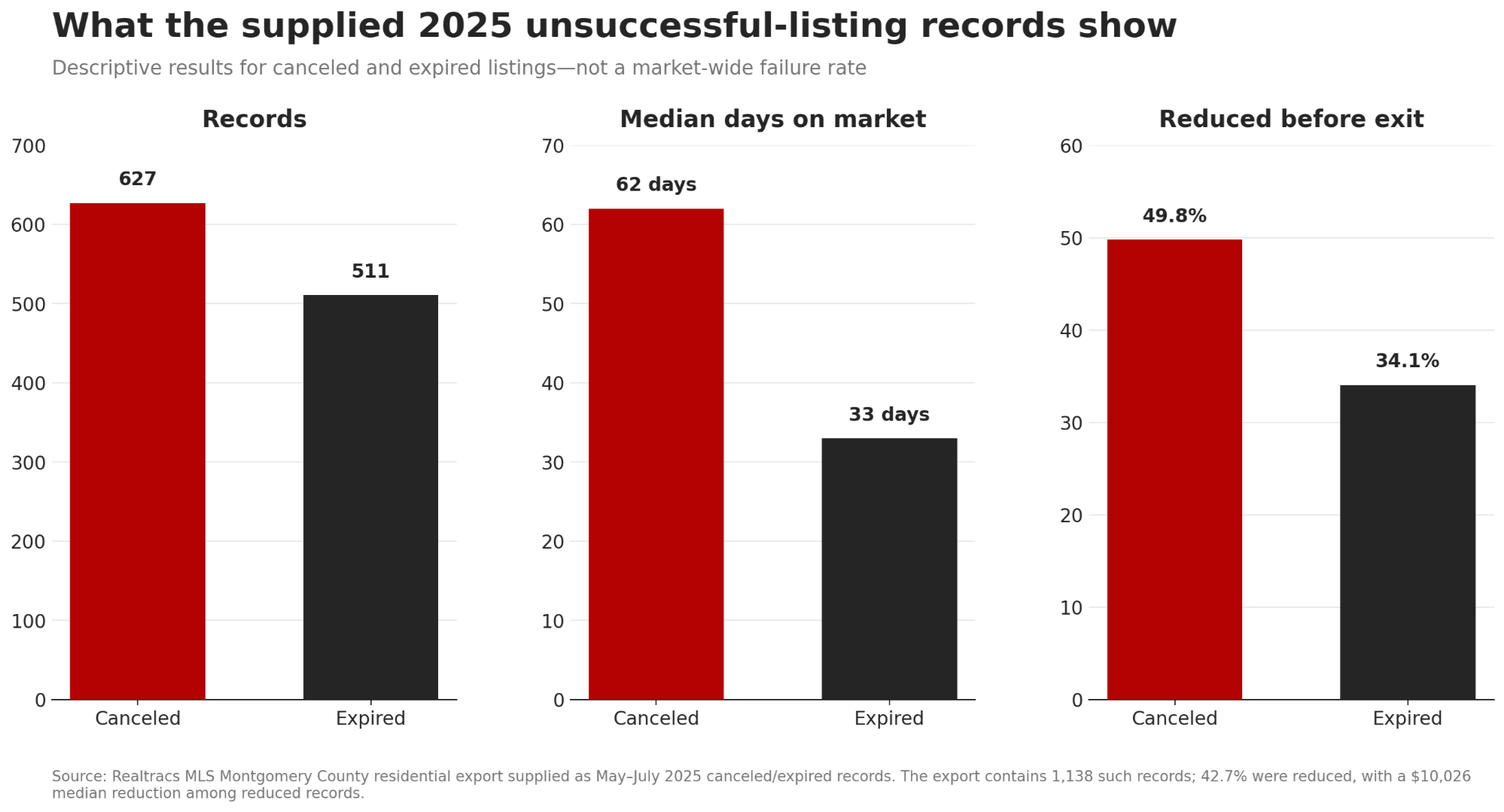
I analyzed the canceled and expired residential records in the supplied Realtracs MLS export. The results describe those records; they are not a market-wide failure rate.
| Metric | Canceled | Expired | Combined |
|---|---|---|---|
| Records | 627 | 511 | 1,138 |
| Median days on market | 62 | 33 | 56 |
| Listings with a price reduction | 49.8% | 34.1% | 42.7% |
| Median reduction among reduced records | $10,000 | $13,300 | Approximately $10,026 |
The market-time distribution was not one-sided. About 35.7% of the records had 30 days or less on market, while 28.4% had more than 90 days. Some listings ended quickly; others remained available for months.
Properties marked New or To Be Built represented 50.1% of the canceled and expired set. That matters because resale sellers are not competing only with another homeowner down the street. Depending on price and location, they may also be competing with builders offering new finishes, warranties, closing-cost assistance or financing incentives.
What These Numbers Do—and Do Not—Prove
The data proves that these MLS records ended as canceled or expired and describes their recorded price histories and market times. It does not reveal the owner’s motivation, the showing feedback, the condition of each home or whether the property sold later under another listing.
The supplied historical file also did not contain a comparable set of 2025 closed records. Therefore, I cannot calculate the percentage of all 2025 listings that canceled or expired or compare these properties with every successful 2025 sale.
That limitation is important. The goal is not to turn an incomplete denominator into a dramatic statistic. The value is in using the patterns to ask better questions before listing or relisting a specific home.
Why a Price Reduction May Not Fix the Problem
A reduction can be necessary and effective, but only when it changes how buyers compare the property with its alternatives. A small reduction that leaves a home in the same competitive position may produce a new notification without changing the buyer’s decision.
The National Association of REALTORS® pricing guide explains that pricing should reflect comparable sales, property condition, market conditions and the seller’s timeline. Current competition matters too. Closed sales show what buyers previously paid; active and pending properties help show what buyers are choosing now.
Before reducing, sellers should ask:
- Will the new price place the home against a meaningfully different group of competitors?
- Are buyers objecting to price, condition, location, layout or a combination?
- Would repairing a visible issue improve buyer confidence more than the same amount removed from the price?
- Could a buyer incentive address cash-to-close or financing concerns more directly?
- Has new construction changed the value comparison since the home was listed?
In the August 11, 2026 Montgomery County active residential export, 38.8% of listings had been reduced from their original price, with a $10,000 median reduction. A price cut is therefore not unusual—but it is not a strategy by itself.
Presentation Determines Whether Buyers Take the Next Step
Most buyers encounter the home online before deciding whether to schedule a showing. NAR reported that 81% of buyers considered listing photos the most useful feature during an online home search. Good photography cannot correct an unsupported price, but weak images can prevent a well-priced home from receiving serious attention.
Presentation also affects what happens after the click. According to NAR’s 2025 Profile of Home Staging, 83% of buyers’ agents said staging made it easier for buyers to visualize a property as their future home. Nearly half of sellers’ agents reported that staging reduced market time.
Staging does not have to mean renting a house full of furniture. It can mean:
- Cleaning and decluttering enough for rooms to read clearly in photographs
- Removing excess furniture that makes spaces feel smaller
- Using neutral, consistent presentation rather than distracting décor
- Correcting obvious maintenance issues that cause buyers to expect larger problems
- Making sure the online presentation matches what buyers experience in person
Fannie Mae’s home-selling guidance similarly recommends keeping presentation simple, neutral and free of clutter so the home appeals to a wider range of buyers.
Property Condition Changes the Buyer’s Value Calculation
Buyers rarely evaluate a repair only by its contractor estimate. They may also add inconvenience, uncertainty and the possibility of discovering another problem. A seller does not necessarily need to complete every project, but should understand how visible defects affect the home’s competitive position.
NAR’s preparing-to-sell guide recommends obtaining estimates for significant repairs even when the seller does not plan to complete them. That gives the seller better information when deciding between repairing, pricing around the condition or considering a buyer concession.
The strongest pre-listing improvements are usually property-specific. Fresh paint may help one home; another may need roof documentation, HVAC service records, improved lighting or attention to an obvious moisture concern. The right question is not, “What upgrade is popular?” It is, “What issue is most likely to weaken buyer confidence in this house?”
Showing Access Can Quietly Limit Demand
A buyer cannot choose a home they cannot reasonably see. Repeatedly declined appointments, very narrow showing windows, difficult notice requirements or poor communication can reduce the number of buyers who reach the property.
Sellers should establish a showing plan before the listing becomes active:
- How much notice is actually necessary?
- Which hours or days are unavailable?
- How quickly will showing requests be answered?
- How will pets, tenants, alarms or gates be handled?
- Can the home accommodate second showings or inspections on a buyer’s timeline?
Access is not about giving up reasonable boundaries. It is about knowing that every additional restriction narrows the opportunity for a qualified buyer to experience the home.
New Construction Changes the Competition
New construction represented 50.1% of the historical canceled and expired set. It also represented 33.7% of active residential listings in the August 11, 2026 detail export.
Among July 2026 closings, positive seller participation was recorded on 56.9% of new-construction sales compared with 36.0% of resale and other sales. That does not mean every builder offered the same incentive. It means sellers should compare more than list prices.
A buyer may consider:
- Closing-cost assistance and financing incentives
- Included appliances, blinds, fencing or upgrades
- Warranty coverage and expected maintenance
- Completion date and move-in timing
- Lot size, location and neighborhood maturity
A resale home may compete well through location, established landscaping, improvements, lot characteristics or immediate availability. The listing strategy has to communicate those differences clearly.
Use a 7–14 Day Listing Checkpoint
A seller should not panic after one quiet weekend, but the first one to two weeks provide useful evidence. The review should examine where buyer interest is breaking down.
| Observed Pattern | Questions to Investigate |
|---|---|
| Low online attention | Are the price, lead photo, description and property details competitive enough to earn a closer look? |
| Online views but few showings | Does the listing create a price, condition or location concern before buyers schedule? |
| Showings but no second visits or offers | What do buyers experience in person that the online presentation does not resolve? |
| Offers well below expectations | Are buyers consistently discounting the same repair, feature or competitive disadvantage? |
| Interest but difficult scheduling | Are access restrictions causing buyers to choose easier alternatives? |
These patterns are diagnostic clues, not automatic conclusions. The response should be based on repeated evidence, new competing listings, recent pending activity and direct buyer feedback.
What Should You Change Before Relisting an Expired Home?
Relisting with a new date and the same strategy may reproduce the same result. Before returning to the market, review seven areas:
- Current value: Rebuild the pricing analysis using recent comparable sales, pending activity and current competition.
- Previous response: Separate repeated buyer objections from isolated opinions.
- Condition: Decide which repairs, documentation or estimates would improve confidence.
- Presentation: Rework photographs, room preparation, remarks and the order in which features are presented.
- Access: Remove avoidable obstacles to showings, second visits and inspections.
- Terms: Evaluate price, closing timeline, included items and possible concessions together.
- Measurement: Agree in advance on what will be reviewed after the first 7–14 days.
The timing and mechanics of relisting can depend on the existing listing agreement, MLS rules and the seller’s circumstances. Review those details before making changes.
Questions to Ask a Listing Agent Before Trying Again
- Which active and pending homes are my most direct competition?
- How do builder incentives affect my price range?
- What does the previous listing’s activity suggest—and what remains unknown?
- What should change before new photography and marketing begin?
- How will showing feedback and online activity be reported?
- What evidence would justify a price or terms adjustment?
- How will you distinguish my property from similar available homes?
A useful listing conversation should produce more than a recommended price. It should produce a plan for preparation, launch, measurement and adjustment.
The Practical Conclusion
The 1,138 canceled and expired records do not prove that every property was overpriced or poorly marketed. They do show that 42.7% had already been reduced and still left the market under that listing record. A later price cut cannot always repair a weak competitive position.
If your Clarksville or Montgomery County home expired, was canceled or is receiving little activity, I can review the previous listing alongside current competition, recent sales and relevant builder incentives. The goal is to identify what should actually change before you list again.
Use my Clarksville home-selling guide to prepare for the process, review recently sold homes, or contact me for a property-specific listing review.
MLS statistics describe groups of listing records and do not determine why an individual property left the market or what it will sell for. Results vary by location, property type, condition, price range, seller goals, marketing, contract terms and financing. Obtain property-specific real estate, legal, tax, lending and insurance guidance before making a major decision.
Sources and Methodology
- Realtracs MLS Montgomery County residential export supplied as May–July 2025 canceled, expired and closed records. This article uses the 627 canceled and 511 expired records. The export did not contain comparable 2025 closed dates, so no market-wide failure rate was calculated.
- Realtracs MLS Montgomery County residential detail export through August 11, 2026, used for active price-reduction, new-construction and seller-participation context.
- National Association of REALTORS®: What Goes Into Pricing Your Home
- National Association of REALTORS®: 2025 Profile of Home Staging
- National Association of REALTORS®: How to Maximize Online Visibility for Every Listing
- National Association of REALTORS®: Preparing to Sell Your Home
- Fannie Mae: The Home-Selling Process
George Scott, REALTOR®
Keller Williams Realty Clarksville
TN License #377474
Cell: (931) 385-5195 | Office: (931) 648-8500
Email: GeorgeScott@kw.com
2271 Wilma Rudolph Boulevard, Clarksville, TN 37040
Categories
- All Blogs 52
- Clarksville Montgomery County Market Updates 12
- Community Events and Local News 9
- First Time Homebuyer Resources 19
- Holidays at Home 4
- Home Buying Tips 27
- Home Improvement and Maintenance 6
- Home Selling Tips 11
- Military and PCS Moves 4
- Mortgage and Financing 2
- Moving to Clarksville 5
- Neighborhood Guides 10
- Real Estate Glossary and FAQs 8
- Real Estate Investing 2
- Renter's Resources 5
- Style and Design 3
Recent Posts