How to Research Any Clarksville Address Before Making an Offer: 12 Official Checks
Home Buying Tips | Information and official links verified August 13, 2026
The listing may say four bedrooms, low taxes, no flood zone and high-speed internet. That is a useful starting point—but it is not the same as verifying the exact property.
In Clarksville and Montgomery County, one address can uncover questions that change the monthly payment, insurance cost or intended use. A Clarksville mailing address may sit outside city limits. A remodeled room may not match permit or septic records. A nearby road or rezoning case may affect how you feel about the location.
That is why address research is part of my normal buyer process. When a buyer and I find a home worth serious consideration, I start a property research file, check available official and MLS sources, request documents, flag inconsistencies and keep open questions tied to the transaction timeline.
I do not replace inspectors, surveyors, lenders, insurers, title professionals, attorneys or government agencies. I help buyers know what to ask, where to ask it and what still needs confirmation.
The quick answer: How do I research a house before buying?
I research the property in two rounds.
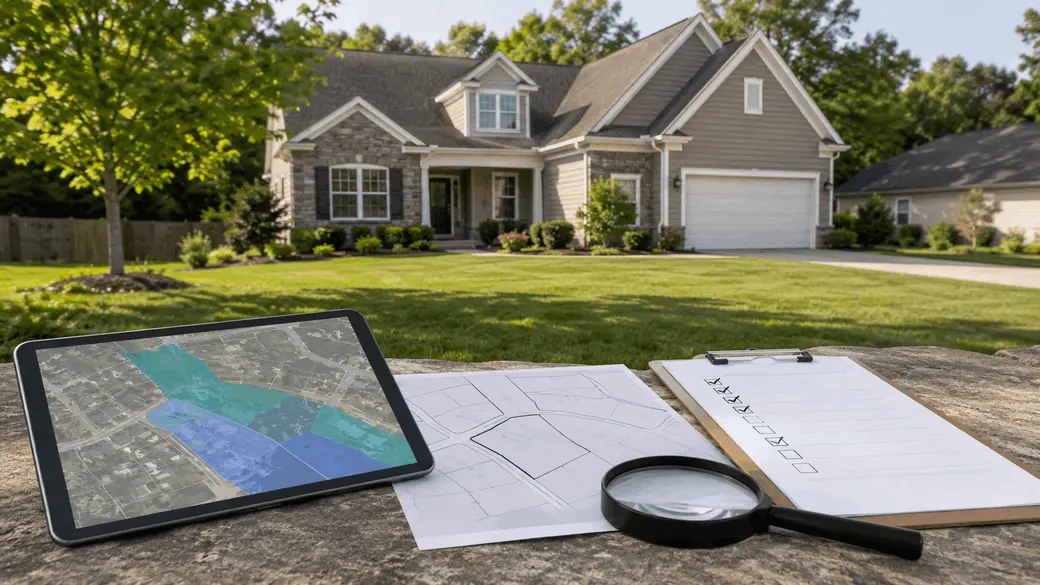
Before we make an offer, we screen the facts most likely to change your interest or price: the exact parcel, city limits, flood map, zoning, taxes, schools, utilities, nearby plans, available listing history and any HOA restrictions that apply.
If the offer is accepted, we use the deadlines in the signed contract to complete the deeper work: inspections, permits, the HOA’s remaining financial and administrative records, sewer or septic records, insurance underwriting, title work and any survey or specialist review you choose.
| Stage | Goal | Typical work |
|---|---|---|
| Before the offer | Find obvious cost or use conflicts | Parcel, city limits, flood, zoning, taxes, schools, utilities, nearby plans, HOA restrictions and MLS history |
| After acceptance | Obtain documents and professional findings | Inspection, permits, remaining HOA financial records, septic or sewer documents, insurance, title and survey questions |
| Before each deadline | Resolve anything that could change the decision | Written confirmations, estimates, revised terms or a decision based on the contract and professional advice |
A basic online screen can start quickly, while records requests, HOA packages, insurance underwriting and specialist opinions may take longer.
You should not have to master 12 databases alone. I help identify the right portals, pull available MLS and public information, organize document requests and route technical or legal questions to the right professional.
12 checks for any Clarksville-area address
1. Confirm the exact parcel and whether it is inside Clarksville city limits
Why it matters: City limits can affect the permit office, property-tax calculation and utility questions. A Clarksville mailing address or ZIP code does not settle the issue.
Start with the Montgomery County Assessor property search and the Clarksville-Montgomery County Regional Planning Commission map portal.
Record the parcel number, legal description or subdivision, acreage, mapped boundary and city-limit status. Make sure the parcel shown on the map is the property we toured.
If the boundary is unclear, request written confirmation from the responsible department. I start the research file here because every later check depends on using the correct parcel and jurisdiction.
2. Check the FEMA flood map—and the house’s location on the parcel
Why it matters: A mapped flood zone can affect risk, lender requirements, insurance cost and resale. Being outside a high-risk zone does not guarantee that a property will never flood.
Search the address in the FEMA Flood Map Service Center. Save the flood zone, panel number, effective date and available map.
Confirm the map pin is on the correct parcel. Then look at where the house—not merely the overall parcel—sits relative to the mapped flood boundary.
Check Montgomery County’s flood-information page for local contacts and map-change documents. Ask for any available elevation certificate, Letter of Map Amendment, flood claim information, drainage documentation or previous flood-related repairs.
If water risk matters, obtain a property-specific flood insurance quote. Standard homeowners insurance generally excludes flood damage.
3. Review permits, final inspections and unresolved work
Why it matters: The finished room, deck, pool or detached garage you are paying for may not match the available permit and assessor records.
For homes inside Clarksville, start with the City of Clarksville Self Service Portal and City Building & Codes.
For county jurisdiction, use Montgomery County Building & Codes.
Look for the permit, required inspections and final approval—not only a permit application. Compare the available records with the listing and what we saw at the property.
Pay particular attention to room additions, garage conversions, finished basements, decks, covered patios, pools, detached buildings and major electrical, plumbing or mechanical work.
Finding no online result does not prove that work was unpermitted. It means we should confirm the correct jurisdiction and request the available records.
4. Verify zoning and check nearby development cases
Why it matters: Zoning affects what you and nearby property owners may be able to do.
This is important if you are considering a rental property, home business, accessory dwelling, fence, pool, addition, detached garage, workshop or future lot division.
Use the RPC maps to identify the current zoning classification, growth-plan area and mapped overlays.
Then review the RPC’s current zoning, subdivision, site-plan and annexation cases near the property.
A zoning-map label is not approval for a specific use. Likewise, a proposed subdivision or development is not a promise that construction will occur. If an intended use matters to your purchase, obtain an answer from the responsible planning or codes authority before relying on it.
5. Confirm every utility—including internet—by exact address
Why it matters: “Utilities available” can mean a line is nearby, not necessarily that the house is connected. Availability and setup costs can affect move-in plans and the monthly budget.
Confirm electric, water, public wastewater or septic, natural gas or propane, trash service and internet separately.
Inside Clarksville, begin with Clarksville Gas & Water and the City’s CDE Lightband service information.
For internet, the FCC National Broadband Map shows provider-reported technologies and speeds at individual locations. Confirm actual service, speed, equipment and installation costs directly with the provider.
For a property with a private well, TDEC provides a water-well map and Driller’s Report process. An appropriate professional can help evaluate water testing and equipment condition.
Seller utility bills can provide context, but household size, thermostat settings and service plans mean their costs may not match yours.
6. Verify the tax bill and estimate the correct monthly cost
Why it matters: A listing may show an older bill, an exemption-influenced amount or county-only taxes for a parcel inside Clarksville city limits.
Use the Assessor’s information for the appraised and assessed value. Then use the Montgomery County Trustee and, when applicable, the City of Clarksville property-tax search for the actual bill and payment status.
The Montgomery County Assessor’s 2026 calculator lists a 25% residential assessment ratio, a county rate of $2.10 per $100 of assessed value and a City of Clarksville rate of $1.01, for a combined city and county rate of $3.11.
| Illustrative $350,000 appraised value | 2026 rate used | Estimated annual tax |
|---|---|---|
| County jurisdiction only | $2.10 per $100 assessed | $1,837.50 |
| Inside Clarksville city limits | $3.11 combined per $100 assessed | $2,721.25 |
Illustration only: $350,000 × 25% = $87,500 assessed value. Actual bills can differ because of the official appraisal, exemptions, tax year, proration and rounding. Rates and assessments can change.
For a renter preparing to buy, remember that the full monthly housing cost is more than principal and interest. It can also include property taxes, homeowners insurance, mortgage insurance, separate flood coverage, HOA dues, utilities, maintenance and repairs.
The purchase price may attract your attention, but the complete monthly cost determines whether the home fits your budget.
7. Check current school zoning by exact address
Why it matters: A ZIP code, subdivision name, nearby school or previous listing does not confirm the current school assignment.
Use the CMCSS Bus and Zoning Information page for address-specific information and the current elementary, middle and high school maps.
Check transportation eligibility separately from school assignment. School zones and transportation routes may change.
My Clarksville-Montgomery County school-zone guide explains the address-level process in more detail. CMCSS remains the authority for assignment and transportation questions.
8. Review planned roads and nearby growth
Why it matters: A future project may affect traffic, access, construction activity, nearby land use or resale—but only if you understand its actual status.
Check the Clarksville Urbanized Area MPO transportation page, its current Transportation Improvement Program and the TDOT project portal.
Then check current RPC cases for nearby rezonings, subdivisions, site plans and annexations.
Record the date and project phase. “Proposed,” “adopted,” “funded,” “in design,” “right-of-way acquisition” and “under construction” do not mean the same thing.
Plans and schedules can also change. For more context, see my guide to Clarksville growth and real estate.
9. Read the HOA restrictions before making an offer
Why it matters: HOA dues are only one part of the review. Restrictions can directly conflict with how you plan to use the property.
Before we make an offer, I help review the available declaration or restrictive covenants, recorded amendments, bylaws and current rules.
We look specifically for provisions involving rentals, pets, fences, sheds, pools, parking, work vehicles, home businesses and exterior changes.
We also confirm the current dues and any known transfer charges or special assessments that could affect your cost.
If the complete financial or administrative package is not available before the offer, we request the remaining documents as early as possible. Those may include the current budget, financial statements, meeting minutes, association insurance information and pending or approved special assessments.
The goal is to understand the restrictions before offering and then complete the broader HOA review within the applicable contract timeline.
The Montgomery County Register of Deeds holds recorded documents. Current budgets, minutes and operating rules generally come from the seller, association or management company.
I help request and organize the package. A title professional or Tennessee attorney should explain unclear restrictions, easements or legal questions.
10. Confirm public sewer, septic records and permitted bedroom count
Why it matters: Public water does not prove public sewer, and a septic permit may not support the bedroom count advertised in the listing.
For public wastewater, ask the utility to confirm that the house is connected—not merely that a sewer main is nearby.
For septic, search the TDEC Septic Tank Permit database for the construction permit, septic layout, completion records and permitted bedroom count.
Compare the permitted bedroom count with the listing and how you intend to use the property.
Have the tank, field lines, reserve area and access evaluated by an appropriate professional. Planned additions, pools, garages, driveways and grading may interfere with septic components even when the existing system is working.
11. Get insurance quotes before the property becomes emotionally expensive
Why it matters: Insurance can change affordability or loan eligibility.
Roof age and condition, previous claims, electrical wiring, plumbing, heating systems, pools, detached structures, business use and rental plans may all affect underwriting, coverage or cost.
Request written quotes from more than one licensed insurance professional using comparable coverage and deductibles.
The Consumer Financial Protection Bureau recommends comparing price and coverage and sharing the quote with your loan officer. Ask separately about flood insurance when relevant.
A C.L.U.E. report generally contains up to seven years of claims history and may be used by insurers. Ask the seller for available property-claim information and let the insurer complete its own underwriting.
I help buyers start this conversation early—not during closing week.
12. Compare listing history with assessor, deed and title records
Why it matters: Repeated relisting, major description changes, ownership transfers or conflicting square footage may point to questions worth answering.
As part of my normal process, I pull the available MLS history for the property, including previous list dates, list prices, status changes, prior photos and previous listing remarks.
I then compare that information with Assessor ownership and sales history, Assessor improvement data, the recorded deed and plat, permit records, seller documents and available title information.
A difference is not automatically a defect or deal breaker. It is a prompt to ask better questions:
- What changed?
- Who completed the work?
- Is there a permit or invoice?
- Why did the previous transaction end?
- Why does the square footage differ?
A title examination and survey address issues that an MLS or tax record cannot.
Five findings that should slow the conversation down
- The listing markets four bedrooms, but the available septic record appears to permit fewer.
- A garage conversion, addition, deck or pool has no clear final approval in the available records.
- The home is outside a mapped high-risk flood zone, but drainage, prior water information or the house’s location still raises questions.
- The payment estimate uses county-only taxes even though the parcel appears to be inside Clarksville city limits.
- An HOA restriction, utility limitation or zoning rule conflicts with how you plan to use the property.
These findings do not automatically mean “walk away.” They mean “do not guess.”
Get the document, written answer, inspection, quote or professional opinion while you still have the appropriate opportunity to make a decision.
Use a simple green, yellow or red result
| Status | Meaning | Action |
|---|---|---|
| Green: verified | The source and property information align. | Save the result and date checked. |
| Yellow: confirm | The answer is missing, unclear, outdated or inconsistent. | Request the document or written answer and track the deadline. |
| Red: decision item | The finding may affect cost, financing, insurance, intended use or willingness to proceed. | Obtain the appropriate professional advice and make a decision based on the contract. |
The goal is not to find a property with a perfectly empty file. The goal is to understand what you are buying, identify unresolved questions and make decisions while the appropriate options are still available.
Common questions from Clarksville buyers
Will you do these searches for me?
Yes. Helping organize this due-diligence research is part of my normal buyer process.
I identify the appropriate sources, pull available MLS and public information, request documents, flag mismatches and keep unanswered questions visible.
The seller, HOA, utility, government agency or licensed specialist must provide or confirm some answers. I help make sure those questions reach the correct source.
Do all 12 checks have to be finished before an offer?
No. We first screen the answers most likely to change your interest, price or offer terms.
That pre-offer screen includes applicable HOA restrictions, especially when your plans involve rentals, pets, fencing, parking, exterior changes, a workshop or a home business.
Some financial, administrative and technical records require more time or seller cooperation. The property and signed contract determine what must be resolved next.
Can a house flood if FEMA does not show it in a high-risk zone?
Yes. FEMA maps show mapped flood hazards; they do not promise that flooding will not occur elsewhere.
Consider drainage, the house’s location on the parcel, seller information, local records and insurance options in addition to the FEMA map.
Can I trust the taxes, schools, square footage and utilities in the listing?
Treat the listing as a starting point.
Verify taxes with the Assessor and tax collectors, school assignment with CMCSS and utility availability with each provider. Measurements and physical condition should be addressed through the appropriate appraisal, inspection or survey process.
Is this the same as a home inspection or title search?
No. Address research helps identify questions and records. A home inspection evaluates physical condition. Title work addresses ownership and recorded title matters. A survey addresses boundaries and certain physical matters.
Insurance, lending, zoning and environmental questions each require their own source or professional.
Want this level of preparation when you buy?
When a buyer and I find a home worth serious consideration, we talk through what matters to them—monthly cost, a future rental, a fence or workshop, school assignment, commute, septic capacity, flood concerns or something else.
I then research the property, pull its available history, organize the questions and identify what still needs an official or professional answer before we write an offer or during the appropriate contract timeline.
This is not an extra service a buyer has to remember to request. It is part of my normal process for helping clients evaluate a Clarksville-area home and make a more informed decision.
If you are still looking for the right buyer’s agent, start with my Clarksville home-buying guide, search Clarksville-area homes or contact me to discuss your home search.
You can also call or text me at (931) 385-5195.
George Scott, REALTOR®
Keller Williams Realty Clarksville
Cell: (931) 385-5195 | Office: (931) 648-8500
Email: georgescott@kw.com
Tennessee License #377474
This article is for general educational purposes and is not legal, tax, engineering, surveying, title, insurance, lending, inspection, zoning or environmental advice. Property facts, maps, tax rates, school zones, plans and online records can change or contain errors. Verify the exact property with the responsible agency and qualified professionals before relying on the information.
Categories
- All Blogs 52
- Clarksville Montgomery County Market Updates 12
- Community Events and Local News 9
- First Time Homebuyer Resources 19
- Holidays at Home 4
- Home Buying Tips 27
- Home Improvement and Maintenance 6
- Home Selling Tips 11
- Military and PCS Moves 4
- Mortgage and Financing 2
- Moving to Clarksville 5
- Neighborhood Guides 10
- Real Estate Glossary and FAQs 8
- Real Estate Investing 2
- Renter's Resources 5
- Style and Design 3
Recent Posts