Home Closing Process Tennessee | Clarksville First-Timer's Guide
Closing Day in Clarksville: A First-Timer's Complete Guide
What to expect, what to bring, and why the stack of paperwork waiting at that table is the best thing you'll ever sign.
Quick Navigation: → The Week Before: What Not to Do | → Your Closing Disclosure | → Final Walk-Through | → What to Bring (Closing Checklist) | → Who's in the Room | → What You Sign | → Where the Money Moves | → Wire Fraud Warning | → The Key Handoff | → Quick Stats | → FAQ
The Best Paperwork You'll Ever Sign
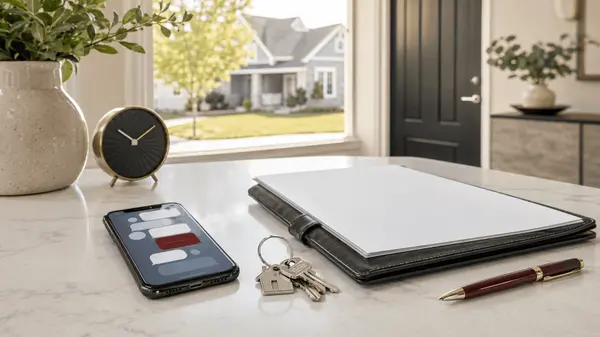
Picture yourself sitting at a table in a Clarksville title company office, pen in hand. There's a stack of documents in front of you and someone saying "initial here, sign here, date here" roughly forty times. It sounds like a lot. It is a lot. And it is, without question, the best paperwork you will ever sign in your life.
Closing day is where everything this series has built toward becomes real. The pre-approval, the house hunt in Sango or St. Bethlehem or north Clarksville, the offer, the inspection negotiations, the appraisal — all of it lands here, at this table. In about 45 minutes, you go from buyer to owner. The keys you receive at the end of that document stack open a home that is legally, officially, completely yours.
I'm George Scott, a buyer's agent with Keller Williams Realty in Clarksville. I've been present at hundreds of closings in Montgomery County, and I'll tell you honestly: this is my favorite day in this business. The anxiety buyers feel in the days leading up to closing almost always turns to genuine joy the moment they walk out of that title company holding their keys. Understanding what's about to happen — before you arrive — is what converts anxiety into readiness.
This guide walks you through the entire home closing process in Tennessee: chronologically, specifically, and practically. Nothing on closing day should surprise you except how good it feels.
The Week Before Closing: What Not to Do (This Is Important) {#week-before}
The five business days before your closing date are the most consequential of the entire transaction. Your lender is completing final underwriting verification — even after you've been cleared to close, they run one last check. This includes confirming your employment is still active, pulling a final credit check, and verifying that no new debt has been taken on since your approval.
The Landmines to Avoid Before Closing Day
This is not the time for any of these:
Financing a car or any vehicle. A new auto loan changes your debt-to-income ratio and triggers a credit inquiry. Either alone can prompt your lender to re-evaluate your file, delay your closing, or in rare cases rescind your approval.
Opening any new credit accounts. This includes store credit cards, personal lines of credit, and buy-now-pay-later accounts. Even a zero-balance new account can affect your qualifying ratios.
Making large cash deposits you can't document. If $8,000 appears in your checking account two days before closing with no clear paper trail, your underwriter will flag it. Every non-payroll deposit above a threshold will need sourcing documentation.
Co-signing a loan for someone else. This puts the debt on your credit profile even if you're not making the payments.
Changing or leaving your job. Even a lateral move to a better-paying position can delay closing if it changes employment type (hourly to salaried, employee to self-employed) or requires re-verification of income.
Three other things running in parallel this week: your lender is preparing and delivering your Closing Disclosure (required at least three business days before closing), your title company is finalizing the deed and preparing all closing documents, and you're confirming and arranging your closing funds transfer — which we'll cover in detail below.
📊 Did You Know? The three-day Closing Disclosure review period was established by the Consumer Financial Protection Bureau as part of the "Know Before You Owe" mortgage rules. The rule gives buyers three business days to review their Closing Disclosure so there are no surprises at the closing table — and time to consult with advisors and ask every question about their final loan terms before signing. Consumer Financial Protection Bureau
Your Closing Disclosure: How I Walk Buyers Through It {#cd}
The Closing Disclosure is a five-page federal document your lender must deliver at least three business days before closing. Think of it as the final, official version of the Loan Estimate you received at the start of the mortgage process — except these numbers are locked.
Here's how I walk through it with buyers when it arrives:
Start with the action, not the reading. Pull out the original Loan Estimate. Open the Closing Disclosure next to it. The format is nearly identical — that's intentional. You're looking for changes, not reading every word cold.
Focus on three categories of fees:
- Fees that cannot change: Your lender's origination charges and required services you didn't shop for. These must be identical to the Loan Estimate.
- Fees that can change up to 10% in total: Title services, settlement fees, and recording charges. Small variances are normal; large ones warrant a call to your lender.
- Fees that can change freely: Prepaid items like homeowner's insurance, prepaid interest, and any services you personally chose and shopped.
Then read each page with context:
What's on Each Page of Your Closing Disclosure
- Page 1 — Your final loan terms, total monthly payment (principal, interest, taxes, insurance), and the cash-to-close amount. This is the number you're wiring or bringing as a cashier's check.
- Page 2 — Complete line-by-line breakdown of all closing costs: origination charges, third-party services, title fees, recording fees, and any credits from the seller or lender. Every dollar affecting your bottom line lives here.
- Page 3 — Transaction summary from both buyer and seller perspectives. Shows total funds you're bringing, how they're applied, and what the seller nets.
- Page 4 — Personal loan disclosures: whether your loan allows negative amortization (almost never), partial payment handling, and your escrow account setup for taxes and insurance.
- Page 5 — Lifetime loan cost: total interest over 30 years, APR, and total interest percentage (TIP).
If something on Page 2 looks significantly different from your Loan Estimate, call your lender before closing day — not at the table. Questions answered in advance keep the closing on schedule.
💡 Fun Fact: Closing costs in Clarksville TN typically run 2–4% of the purchase price after seller concessions are applied — roughly $6,000–$12,000 on a $304,000 home. VA buyers often close with significantly less out of pocket due to seller concession limits and the absence of PMI.
The Final Walk-Through: Your Last Look Before You Own It {#walkthrough}
The final walk-through is not a second inspection. It's a verification — a chance to confirm that the property is in the same or better condition as when you went under contract, that agreed repairs are complete, and that the home has been properly vacated.
Scheduled the day before closing or the morning of. It runs 20–45 minutes. Here's what we are checking:
Agreed repairs are done. If the inspection resulted in credits or repairs, walk through each item on the written agreement and confirm completion.
No new damage from the move-out. Furniture dragged across hardwood, walls nicked during move-out, fixtures removed that weren't supposed to be — these happen. Document anything unexpected with photos.
Agreed items are still present. Appliances, light fixtures, window treatments, and any fixtures contractually included in the sale should be in place.
Utilities are on. Test the HVAC, run faucets, flip switches, check the garage door. You want systems confirmed operational before you sign.
If something's wrong at the walk-through, raise it before you arrive at the title company — not at the signing table. Before signing, you can negotiate a closing cost hold-back, a credit, or insist on resolution. After signing, the leverage is gone. I always attend the walk-through with my buyers because this is precisely when that representation matters.
— We've caught things ranging from minor — a dishwasher that was supposed to stay had been removed — to genuinely significant. Once, a repair that had been agreed to and confirmed wasn't done at all. We addressed it before signing and the seller provided a credit. Had we discovered it at the table, the closing would have been delayed. The walk-through is not a formality. Use it.
🎉 Almost there — and I'll be right there with you. I attend every closing with my Clarksville buyers and review the Closing Disclosure with you before closing day so there are no surprises at the table. If you're approaching closing and want to walk through what to expect, let's talk.
Your Home Closing Checklist: What to Bring (and What to Leave Behind) {#what-to-bring}
One of the most common questions I get in the days before closing is simple: "What do I actually need to bring?" The list is shorter than most buyers expect.
The Four Things You Need
Government-issued photo ID — Driver's license or passport, current and valid. Every person whose name is on the loan must have one. The closing agent is legally required to verify identity before any documents are executed.
Closing funds — As a cashier's check made out to the title company, or as a confirmed wire transfer. Personal checks are not accepted. Get the exact amount from your Closing Disclosure and verify it directly with your title company by phone the business day before closing. (The wire fraud section below explains why this phone call is non-negotiable.)
Any last documents your lender requested — Check your lender's pre-closing list. This might be a final pay stub, updated bank statement, or insurance confirmation.
Proof of homeowner's insurance — Your policy must be active as of the closing date. Have your insurance agent send the binder directly to the title company a few days before closing. Don't leave this for the morning of.
What You Don't Need to Bring
Your checkbook, your six versions of the purchase agreement, that printout of the original Zillow listing, the inspection report, the appraisal report, or any of the accumulated paperwork from the past 45 days. The title company has all of it. Show up, bring the four items above, and let the closing agent do the rest.
Who's at the Closing Table in Clarksville — and Who Isn't {#whos-there}
Tennessee's home closing process has a few characteristics first-time buyers don't always expect.
Attorney vs. Title Company in Tennessee
Tennessee does not legally require an attorney to close a residential real estate transaction. Closing can be conducted by a title company representative or a real estate attorney — both are common in the Clarksville and Montgomery County market. Collins Legal Most standard residential closings in Clarksville happen at a title company office with a licensed closing agent handling the paperwork.
New as of July 1, 2025: A significant change in Tennessee law now gives buyers the exclusive right to choose their own settlement agent. Starting July 1, 2025, Tennessee law gives homebuyers the exclusive right to choose their own settlement agent — the company or attorney that handles closing, escrow, and title insurance. Sellers can no longer require buyers to use a specific settlement agent. McSeveney Law Shop for your title company, compare fees, and choose the provider you trust. This is a meaningful consumer protection that didn't exist before this year.
Do You and the Seller Sign Together?
Usually not. In Middle Tennessee, it's somewhat rare for buyer and seller to sit at the closing table together. Typically the buyer meets with the closing agent first — about 35 minutes — then the seller signs separately, a process that takes about 15 minutes. Mhclosings This is practical, not adversarial. Your appointment and the seller's appointment are coordinated; you just don't share a room.
Who's at the buyer's closing in Clarksville:
- You (and any co-borrowers — every name on the loan)
- Your closing agent (title company representative or attorney)
- Your buyer's agent (that's me)
- Your lender's representative, sometimes by phone or digitally
The seller's agent is typically not in the room with you. Your agent is there to answer questions, advocate if anything unexpected arises, and ensure the closing proceeds correctly.
What You're Signing — In Plain Language {#what-you-sign}
The closing agent walks you through each document. Here are the ones that matter most:
Promissory Note — Your formal legal promise to repay the loan on the terms specified. This is the document that makes you personally responsible for the debt. The key terms — loan amount, interest rate, payment schedule, late fee provisions — should match your Closing Disclosure exactly. Read it.
Deed of Trust — Gives the lender a security interest in your property. If you stop paying, this is the document that enables foreclosure. It does not mean the lender co-owns your home — it means the property secures the loan until it's paid off. This is standard for every mortgage in Tennessee.
Warranty Deed — This is the document that officially transfers ownership from the seller to you. It conveys clear title and the seller's assurance that the property is free of undisclosed encumbrances. After closing, the Warranty Deed is recorded in Montgomery County's public records — the official, permanent proof that you own this home.
Closing Disclosure (your signed copy) — You sign to confirm receipt and review of the final terms. These should match exactly what you reviewed during your three-day window.
Deed Transfer Tax documentation — Tennessee charges $0.37 per $100 of consideration. On a $304,000 purchase, this is approximately $1,125 — accounted for in your Closing Disclosure.
Where the Money Moves at Closing {#money}
After all documents are signed, the closing agent disperses funds simultaneously: your lender receives payoff of any prior mortgage, the seller receives their net proceeds, agents receive commissions, and all third-party service fees are paid. The Warranty Deed is then submitted for recording with Montgomery County.
For VA and FHA loans, there is sometimes a brief funding delay — a few hours while the lender formally confirms the loan on their end. This is routine and managed by your lender and title company. You may receive keys the same day or the following morning depending on timing. I track this for my buyers and communicate the update as soon as I have it, so there's no anxious waiting.
Wire Fraud: The Warning Every Clarksville Buyer Needs to Read Before Closing {#wire-fraud}
Real estate closings are among the most targeted transactions for wire fraud scams. The FBI reports that scammers increasingly target homebuyers during the closing process — through sophisticated phishing attacks, they attempt to divert your closing funds into fraudulent accounts by sending fake wire instructions that appear to come from your title company, agent, or lender. Consumer Financial Protection Bureau
This is not rare. This is not hypothetical. It happens regularly, and the losses are often permanent.
The Rule — No Exceptions
Never wire closing funds based on instructions received by email alone. Before sending any amount to any account, call your title company directly — using a phone number you looked up yourself from their official website, not a number provided in the email — and verbally confirm every digit of the routing and account number.
Before wiring money, confirm instructions with your title company by calling their official, published phone number. Do not call a new number or respond to an unexpected email that contains new or revised wire instructions. Wells Fargo
The Red Flags to Know
- An email arrives with "updated" or "corrected" wire instructions in the final days before closing
- The sender's email address differs even slightly from prior communications
- The message creates urgency — "must wire today or closing will be delayed"
- Instructions arrive by text, not through a verified communication channel
If any of these appear, stop. Call your title company at the number you've had from the beginning of the transaction. Do not call the number in the suspicious message. Do not reply to the email.
Wire fraud is irreversible. Once funds are sent to a fraudulent account, recovery is extremely difficult and often impossible. Thirty seconds of phone verification is all that stands between your closing funds and a permanent loss. Make the call.
The Key Handoff: You're a Homeowner Now {#keys}
When the last document is signed and funds have disbursed, you receive the keys. At or before the handoff, collect:
- All keys — front door, back door, mailbox, any deadbolts
- Garage door remotes and keypad codes
- Community gate codes or HOA access credentials, if applicable
- Appliance manuals and any warranties left by the seller
- Security system information and alarm codes
- Any contractor contacts the seller recommended
Your agent will confirm these items are all accounted for before you leave the table.
📊 Quick Stats: Closing Day in Clarksville TN {#stats}
- Closing time: The buyer's portion of a financed closing in Tennessee typically runs 35–45 minutes (McCann & Hubbard Law Firm; Nashville MLS)
- Documents signed: Financed buyers typically sign 40–50 documents; cash buyers significantly fewer
- Closing costs in Clarksville: Typically 2–4% of purchase price after seller concessions — approximately $6,000–$12,000 on a $304,000 home (NAR; Step 3 of this series)
- Closing Disclosure review: Federal law requires 3 business days — this window cannot be waived except in documented financial emergencies (Consumer Financial Protection Bureau)
- Tennessee law change July 1, 2025: Buyers now have the exclusive right to choose their own settlement agent — sellers can no longer direct closings to a preferred title company (Tennessee SB 394 / HB 569)
Frequently Asked Questions {#faq}
What do I need to bring to closing in Clarksville TN?
Four things: a valid government-issued photo ID for every person on the loan, your closing funds as a cashier's check or confirmed wire transfer, any final documents your lender requested, and proof of active homeowner's insurance. The title company has everything else — your contract, title commitment, inspection reports, appraisal. Arrive on time with those four items and the closing agent handles the rest.
How much are closing costs in Clarksville TN?
Closing costs in Clarksville typically run 2–4% of the purchase price after seller concessions — roughly $6,000–$12,000 on a $304,000 home. VA buyers often close with significantly less out of pocket because there's no PMI and seller concession limits allow the seller to cover a meaningful portion. The full breakdown by loan type is in Step 3 of this series, and your Closing Disclosure will show the exact figure at least three business days before closing. [Full closing cost guide in Step 3 →]
What is on a Closing Disclosure?
The Closing Disclosure is a five-page federal document showing your final loan terms and all closing costs. Page 1 shows your final monthly payment and cash-to-close amount. Page 2 is a line-by-line breakdown of every fee — the most important page to compare against your original Loan Estimate. Page 3 summarizes the full transaction for both buyer and seller. Page 4 covers your personal loan disclosures and escrow setup. Page 5 shows the total lifetime cost of the loan. You receive it at least three business days before closing — use all three to review it carefully.
How long does closing take in Clarksville TN?
The buyer's portion of a financed closing typically runs 35–45 minutes at the title company. Cash closings are shorter, closer to 15–20 minutes. In Middle Tennessee, buyers and sellers usually sign in separate appointments rather than together, so there's no waiting for the other party. Plan an hour of your day to be safe, and schedule any movers or key-related logistics for the afternoon rather than immediately after your closing time in case of any last-minute adjustments.
Does Tennessee require a real estate attorney to close?
No — Tennessee does not require an attorney for residential closings. Most closings in Clarksville and Montgomery County are handled by a licensed title company representative. As of July 1, 2025, a new Tennessee law gives buyers the exclusive right to choose their own settlement agent. Sellers can no longer require buyers to use a specific title company. This is a meaningful win for buyers — shop around, compare fees, and choose the provider you trust.
What are the biggest mistakes buyers make right before closing?
The most common and costly: financing a new vehicle, opening any credit account, making large undocumented cash deposits, or changing jobs in the final week before closing. Each of these can trigger a re-underwriting review, delay your closing, or in rare cases result in loan denial. Your lender runs a final credit and employment verification right before funding. Keep your financial profile exactly as it was when you were approved — no new accounts, no new debt, no major financial moves — until the deed is recorded and the keys are in your hand.
It Ends at a Table in Clarksville, and It Starts the Moment You Walk Out
The home closing process in Tennessee feels complicated until you're sitting at that table — and then it's remarkably straightforward. Three business days to review the Closing Disclosure. A final walk-through the day before. A verified wire transfer you confirmed by phone. Forty-five minutes of signatures. And then keys.
I think about a Fort Campbell sergeant I closed with a few years ago — his third PCS, first home purchase. Thirty years of service, never stayed long enough to own. He sat at the table, signed everything, took the keys from the closing agent, and just went quiet for a moment. Didn't say anything. Just sat there with the keys in his hand.
That moment is why I do this. Every closing is someone's version of that quiet moment.
Closing day is my favorite day in this business. Let's get you there.
Ready to Close? Let's Make Sure You're Completely Prepared — Contact George →
The paperwork only takes 45 minutes. Everything it represents lasts a lifetime.
Series Navigation
⬅ Previous: Step 6 — The Home Inspection in Clarksville: What to Expect and What Matters — Home Inspection Clarksville TN | What to Expect & What Matters - G...
➡ Next: Step 8 — Protecting Your Investment: Homeownership in Clarksville, TN — [URL]
📚 Read the full series: The Home Buyer's Journey — A Clarksville, TN Guide — Your Roadmap to Homeownership in Clarksville, TN - George Scott - K...
Sources & Citations
Consumer Financial Protection Bureau (CFPB). When Do I Get a Closing Disclosure? August 2024. consumerfinance.gov/ask-cfpb/when-do-i-get-a-closing-disclosure-en-179
Consumer Financial Protection Bureau (CFPB). Know Before You Owe: You'll Get 3 Days to Review Your Mortgage Closing Documents. 2015 / updated 2024. consumerfinance.gov/about-us/blog/know-before-you-owe
Consumer Financial Protection Bureau (CFPB). Mortgage Closing Scams: How to Protect Yourself and Your Closing Funds. consumerfinance.gov/about-us/blog/mortgage-closing-scams
McCann & Hubbard Law Firm. What to Expect at Closing. Brentwood, TN. mhclosings.com/legal_services/what-to-expect-at-closing
Tennessee General Assembly. SB 394 / HB 569 — Tennessee Settlement Agent Selection Rights Act. Effective July 1, 2025. mcseveneylaw.com/post/tennessee-s-new-settlement-agent-law
Collins Legal. Tennessee Real Estate 101: Do You Really Need an Attorney to Close the Deal? September 2023. collins.legal/blog/is-an-attorney-required-in-tennessee
Amitree. Tennessee Home Buying and Escrow Process. July 2021. amitree.com/resources/real-estate/tennesee-homebuying-and-escrow-process
Nashville SMLS / Gary Ashton. Real Estate Closings: How Does the Home Closing Process Work? November 2025. nashvillesmls.com/blog/get-to-know-the-home-closing-process
Veterans United. The Closing Disclosure: A Page-by-Page Breakdown. veteransunited.com/education/closing
Wells Fargo. Five Tips to Help Avoid Online Wire Transfer Fraud. wellsfargo.com/privacy-security/fraud/articles/safety-tips-wire-transfers
Rocket Mortgage. How to Avoid Mortgage Wire Fraud. January 2024. rocketmortgage.com/learn/mortgage-wire-fraud
HomeLight. Tennessee Sellers: Prepare for These 11 Closing Costs. July 2025. homelight.com/blog/closing-costs-in-tennessee
Tennessee Department of Revenue. Recordation Tax — Deed Transfer Rate: $0.37 per $100 of consideration. Updated 2026. tn.gov/revenue
National Association of Realtors. 2025 Profile of Home Buyers and Sellers. November 2025. nar.realtor/research-and-statistics
Keller, Gary, Jay Papasan, and Dave Jenks. Your First Home: The Proven Path to Homeownership. McGraw-Hill, 2008.
George Scott | Keller Williams Realty | Clarksville, TN 📞 931-385-5195 | ✉️ Georgescott@kw.com | 🌐 buygeorgehomes.com Serving Clarksville, Fort Campbell, and Montgomery County
Categories
- All Blogs 40
- Clarksville Montgomery County Market Updates 9
- Community Events and Local News 9
- First Time Homebuyer Resources 17
- Holidays at Home 4
- Home Buying Tips 22
- Home Improvement and Maintenance 5
- Home Selling Tips 7
- Military and PCS Moves 4
- Mortgage and Financing 2
- Moving to Clarksville 5
- Neighborhood Guides 10
- Real Estate Glossary and FAQs 5
- Real Estate Investing 2
- Renter's Resources 4
- Style and Design 3
Recent Posts